
Should I Repair or Replace Water Heater?
A cold shower usually settles the question fast: should I repair or replace water heater problems, or am I about to throw money at a unit that is already on its way out? When hot water gets unreliable, the right answer depends on the heater’s age, the type of failure, the repair cost, and how much risk you can tolerate if the system quits completely.
If you are dealing with no hot water, rusty water, leaking around the tank, or strange banging noises, this is not the time to guess. Water heater problems can move from inconvenience to property damage quickly, especially in a home, rental, restaurant, or commercial building that depends on steady hot water every day.
Should I Repair or Replace Water Heater Issues Based on Age?
Age is one of the biggest decision points. A standard tank water heater often lasts around 8 to 12 years. Tankless units can last longer, often 15 to 20 years, if they have been maintained properly. If your tank water heater is already pushing the 10-year mark and starts having repeated problems, replacement usually makes more financial sense than another repair.
That does not mean every older heater must be replaced immediately. If the issue is minor, such as a thermostat, heating element, pilot assembly, or pressure relief valve, a repair can still buy you useful time. But once you are paying for repeated service calls on an aging unit, the math changes fast.
If the system is newer, repair is often the smart move. A five-year-old heater with one failed component is very different from a twelve-year-old tank with corrosion, sediment buildup, and signs of leakage. Newer units still have life left, and a targeted repair can restore dependable performance without the larger upfront cost of installation.
When Repair Is Usually the Better Option
Some water heater problems are annoying but fixable. If the tank itself is still sound, replacing a part is often the most practical path.
A repair is often worth it when the problem is isolated. Common examples include a bad heating element on an electric heater, a faulty thermocouple, a broken thermostat, a worn gas control valve, or a pilot light issue. These are component failures, not full-system failures.
Repair also makes sense when the unit is relatively young and has a clean service history. If it has not been leaking, rusting, or losing efficiency for months, a professional repair can restore it quickly and keep your costs under control.
Another good reason to repair is timing. If the heater fails unexpectedly and you need hot water back right away, a same-day repair may be the fastest solution, especially if replacement options require scheduling, code upgrades, or additional work. For landlords and commercial property owners, getting service restored fast can matter just as much as long-term planning.
When Replacement Is the Smarter Call
If the tank is leaking, replacement is almost always the answer. Once the tank body itself has failed, there is no reliable repair that will reverse that damage. A leaking tank can worsen quickly and lead to flooring damage, wall damage, and mold risk.

Replacement is also the better choice when repairs are stacking up. If you have already paid for one or two fixes and the heater still struggles to deliver enough hot water, it is likely nearing the end of its usable life. At that point, another repair can become a temporary patch instead of a real solution.
Rust-colored water is another serious warning sign. In some cases, rusty water comes from the plumbing system rather than the water heater, but if the corrosion is inside the tank, replacement is often close. Rumbling or popping sounds can also point to heavy sediment buildup. Sediment reduces efficiency, forces the system to work harder, and can shorten tank life.
Higher utility bills can also push the decision toward replacement. An older heater may still function, but if it is running inefficiently and struggling to keep up, you may be paying more every month for worse performance. Replacing it can improve reliability and reduce operating cost.
The Cost Question: Repair vs. Replace
Most property owners want a clear rule, but the answer depends on the size of the repair and the condition of the unit. A common guideline is this: if the repair cost approaches half the cost of replacement on an older heater, replacement is usually the safer investment.
That is especially true if the unit is out of warranty. Spending several hundred dollars on a major repair for a heater already near the end of its lifespan can leave you paying twice – once for the repair, then again for replacement not long after.
On the other hand, a modest repair on a newer unit can be a very good value. Paying to replace a failed part is often far cheaper than replacing the entire system, and it avoids unnecessary installation costs.
The real issue is not just today’s invoice. It is total cost over the next one to three years. If a repair gets you dependable hot water without repeated breakdowns, it is money well spent. If it only postpones replacement by a few months, it may not be.
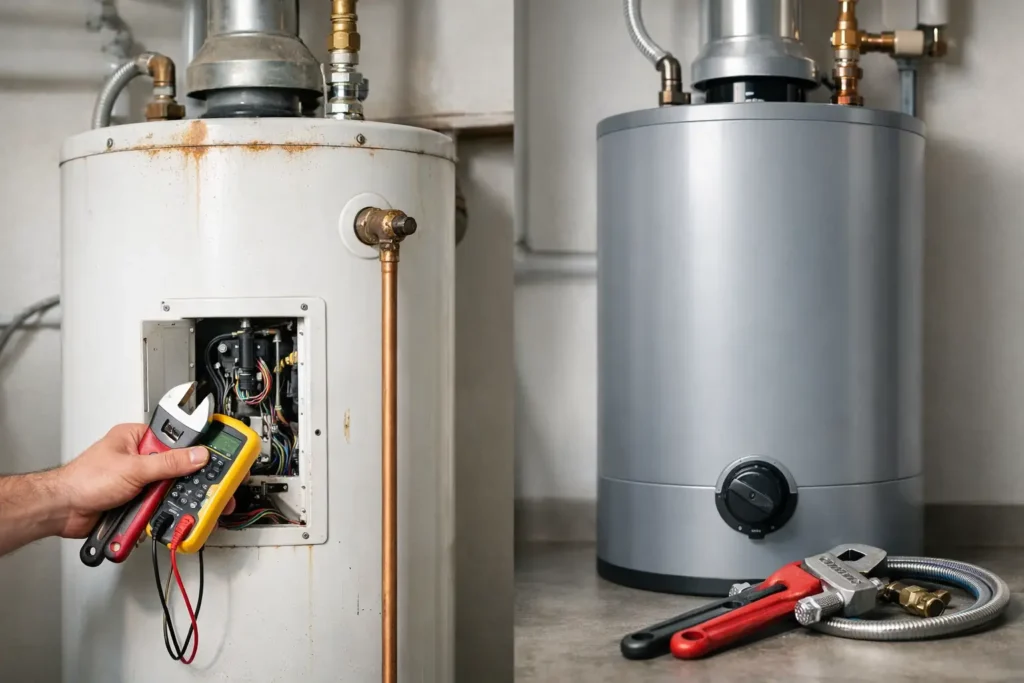
Signs Your Water Heater Is Near the End
Should I Repair or Replace Water Heater if It Still Works?
Yes, sometimes replacement is the better move even if the heater has not failed completely. Partial failure is common. You may still get hot water, just not enough of it, or not consistently.
Watch for warning signs such as fluctuating water temperature, hot water running out too quickly, water that smells metallic, visible rust on fittings, moisture around the base, or frequent resetting on the unit. These symptoms often show up before a full shutdown.
If your heater still works but is becoming unreliable, waiting for total failure can create more disruption than replacing it on your schedule. Planned replacement is usually less stressful than an emergency install after a complete breakdown.

For businesses and rental properties, this matters even more. An unreliable heater can affect tenants, employees, customers, and operations. In those cases, replacement before failure can be the most practical and least disruptive option.
Tank vs. Tankless Changes the Answer
Tank and tankless systems fail differently, and that affects the repair-or-replace decision. Standard tank units are more likely to require replacement once corrosion or tank leakage begins. Tankless systems have more serviceable parts and often justify repair for a longer period, especially if scaling, ignition issues, or sensors are the main problem.
That said, tankless units are not automatically cheaper to fix. Some repairs can be more technical, and maintenance history matters a lot. If a tankless heater has been neglected and has recurring issues, replacement may still be the better long-term call.
Why Professional Diagnosis Matters
Many symptoms overlap. No hot water could be a failed heating element, a tripped breaker, a gas supply issue, a thermostat failure, or a tank that is simply done. Water around the unit might come from a loose connection, a relief valve, or a cracked tank. Those are very different repair decisions.
That is why a proper inspection matters before you commit to either path. A trained plumber can identify whether the problem is a repairable component, estimate remaining system life, and tell you if replacement will actually save money and prevent more downtime.
A good service company should also give you transparent pricing, explain the trade-offs clearly, and avoid pushing a replacement when a repair is still a solid option. If replacement is the smarter call, you should know why, what the timeline looks like, and whether upgrades in capacity or efficiency are worth it for your property.
In the Kansas City area, that is exactly how Kansas City Plumbers Today approaches water heater service – fast diagnosis, no-surprise pricing, and a clear recommendation based on the condition of the unit, not guesswork.
The Best Rule of Thumb
If your water heater is under 8 years old, the issue is minor, and the tank is not leaking, repair is often the right move. If it is over 10 years old, showing signs of corrosion, leaking from the tank, or needing repeated repairs, replacement is usually the better investment.
The middle ground is where expert advice matters most. A nine-year-old heater with one simple part failure may still be worth repairing. A seven-year-old heater with major internal damage may not be. The right call depends on risk, reliability, and whether you want a short-term fix or a long-term solution.
If you are standing in front of a failing water heater trying to decide what makes sense, do not wait for a small problem to become water damage. Get it diagnosed, get real numbers, and make the choice that restores hot water without wasting money.