
Best Water Heaters for Large Families Today
A household of six can drain a standard water heater before the morning rush is over. Two showers, a load of laundry, dishes, and one teenager lingering under hot water can turn a normal routine into cold-water complaints fast. The best water heaters for large families are not always the biggest units on the showroom floor. They are the systems sized for your actual demand, fuel source, plumbing layout, and budget.
For Kansas City homeowners, choosing the wrong water heater can mean higher utility bills, inconsistent temperatures, and an emergency replacement when the old tank finally fails. Start with how your family uses hot water, then select a system that can keep up without wasting energy every day.
What Large Families Need From a Water Heater
Water heater capacity is about more than the number of people in the house. A family of five with staggered showers may use less hot water than a family of four that showers, runs the dishwasher, and washes clothes at the same time each morning.
The key number is your peak-hour demand: the most hot water your household uses during its busiest 60 minutes. A large family often needs 70 to 100 gallons of available hot water in that period, sometimes more. This does not always mean installing a 100-gallon tank. A properly selected unit can recover hot water quickly enough to meet demand with a smaller storage capacity.
Before buying, consider how many bathrooms are used at once, whether you have a large soaking tub, how often laundry runs, and whether your dishwasher or washing machine uses heated water. Also consider future needs. If children are getting older, adding a bathroom, or planning to stay in the home for years, sizing up now may prevent another replacement sooner than expected.
Best Water Heaters for Large Families: Your Main Options
High-Recovery Gas Tank Water Heaters
For many large families, a high-recovery natural gas tank water heater remains the practical choice. These units store a large amount of hot water and reheat it faster than most standard electric tank models. A 50-gallon gas unit may serve some households well, but families with five or more people often benefit from a 60-, 75-, or 80-gallon model, depending on usage.
The most important specification is the first-hour rating, not just the tank size. The first-hour rating estimates how many gallons of hot water the unit can deliver in the first hour after starting with a full tank. If your household needs 85 gallons during the morning rush, choose a heater with a first-hour rating at or above that number.
Gas tank heaters usually have a lower upfront cost than whole-home tankless systems and are familiar to service and replace. The trade-off is standby heat loss. The tank keeps reheating water even when no one is using it, although newer efficient models reduce that waste considerably.
Tankless Water Heaters
A properly sized tankless water heater can provide continuous hot water because it heats water only when a fixture calls for it. This makes tankless systems attractive for busy homes where showers may run back-to-back for hours.
But “endless hot water” does not mean unlimited hot water at every fixture. A tankless heater has a maximum flow rate. If three showers, a dishwasher, and a washing machine run at once, the unit must be capable of heating that combined flow at Kansas City winter groundwater temperatures. Cold incoming water in winter lowers the heater’s effective flow capacity, which is why sizing matters so much.

For a large family, a high-output gas tankless model may work well, especially in homes with natural gas service. Larger homes or households with heavy simultaneous use may need two tankless units or a tankless system paired with a small buffer tank. Electric tankless heaters can be effective for a single fixture or small apartment, but whole-home electric models often require major electrical upgrades and may struggle during peak demand.
Tankless systems cost more to install, particularly if gas piping, venting, electrical service, or water lines need modification. They can offer long-term efficiency and save floor space, but they require routine flushing to control mineral buildup. Hard water makes this maintenance even more important.
Heat Pump Hybrid Water Heaters
Hybrid water heaters use electricity and heat-pump technology to pull warmth from surrounding air and transfer it into the water. They are among the most efficient tank-style options available and can significantly reduce water-heating energy use over time.
For a large family, look at 65- to 80-gallon hybrid models. These units can store plenty of hot water, and many have a high-demand or hybrid operating mode for busy periods. They are a strong fit for households with a basement, utility room, or garage that has enough surrounding air and clearance.
The limitation is location. A heat pump water heater cools and dehumidifies the room around it, which can be useful in a humid basement but less desirable in a small, conditioned closet. It may also switch to standard electric resistance heating during high demand, reducing some of its efficiency advantage. Still, for a household with suitable installation space and high electric costs, it can be an excellent long-term investment.
Two Water Heaters for High-Demand Homes
Some large homes should not rely on one oversized unit. Two water heaters can divide demand between separate areas of the home, such as an upstairs bathroom group and a primary suite, or serve a basement apartment separately from the main house.
This approach is especially useful in homes with multiple bathrooms, large tubs, long pipe runs, or frequent guests. It also adds a degree of backup. If one unit has a problem, the entire household is not automatically without hot water.
The trade-off is higher equipment, installation, and maintenance cost. It is usually a better solution for large square-footage homes than for a typical family home with moderate demand.
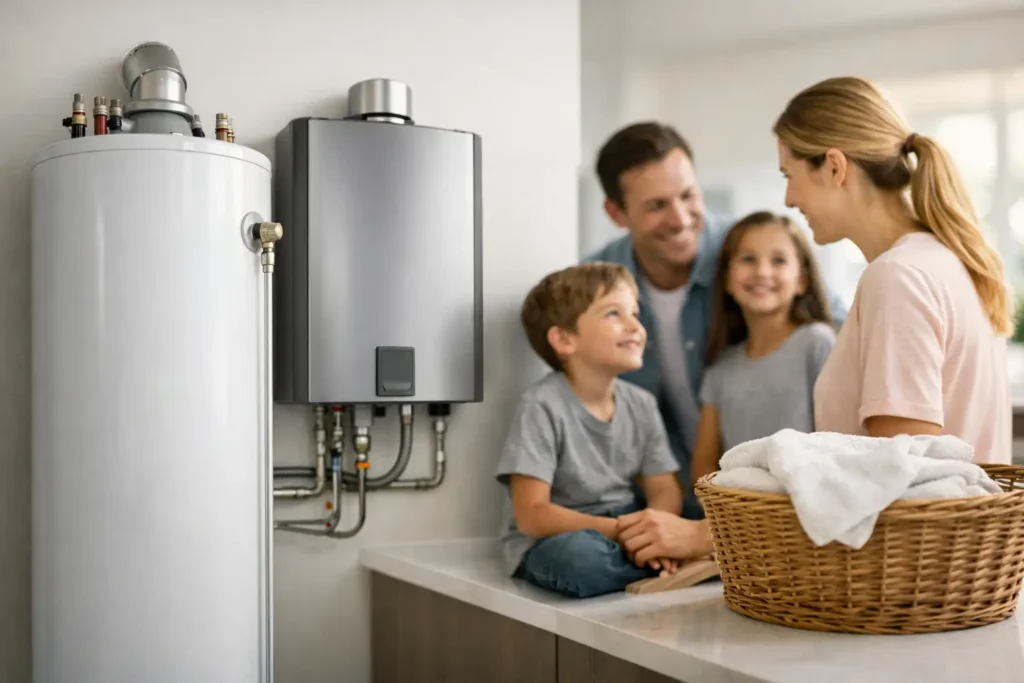
How to Size a Water Heater Without Guessing
Start by listing the fixtures and appliances likely to run during your busiest hour. A typical shower uses roughly 10 to 20 gallons of hot water, depending on length and showerhead flow. A dishwasher may use 4 to 10 gallons, while a warm or hot laundry load can use substantially more.
For a storage-tank water heater, compare your estimated peak demand to the unit’s first-hour rating. Do not choose based on gallons alone. A 50-gallon gas heater with a strong recovery rate may outperform a larger electric tank in a busy home.

For tankless equipment, calculate the gallons per minute required at the same time. Then account for temperature rise: the difference between the incoming cold-water temperature and the temperature you want at the faucet. In winter, Kansas City water can be cold enough that a unit advertised at a high flow rate delivers less hot water than expected.
A professional evaluation also checks details homeowners often miss, including gas-line capacity, venting requirements, electrical panel load, drain access, combustion air, local code, and whether the existing water lines can support the new system. These factors can change which model is truly the best fit.
Fuel Type and Installation Can Change the Answer
Natural gas is often the most practical fuel source for large-family water heating because it supports fast recovery and high-output tankless equipment. If your home already has gas service, upgrading the water heater may be relatively straightforward, though a larger tankless unit may still need a larger gas line.
Electric tank water heaters have a lower installation barrier in many homes, but recovery is slower. They may be suitable when demand is spread out or when installing a hybrid system. Propane can support high-demand heaters in areas without natural gas, but operating costs depend on local fuel pricing.
Do not overlook venting. Older atmospheric gas water heaters may vent through an existing chimney or flue, while high-efficiency condensing tankless models use different vent materials and drainage. A replacement that looks simple can involve meaningful upgrades behind the wall or above the ceiling.
Signs Your Current Water Heater Is Too Small or Failing
Running out of hot water is not always a sizing problem. Sediment buildup, a failed heating element, a worn dip tube, thermostat trouble, or a burner issue can reduce performance. If a heater that once kept up suddenly cannot, schedule service before assuming replacement is the only answer.
Replacement becomes more urgent when you see water around the tank, rust-colored water, corrosion at connections, rumbling noises, repeated pilot or ignition problems, or a unit nearing the end of its expected service life. A leaking tank cannot be repaired safely. Quick action helps prevent water damage and a rushed decision.
Kansas City Plumbers Today can inspect your current system, explain whether repair makes financial sense, and provide clear options for a correctly sized replacement. The right water heater should handle your busiest morning without wasting energy the rest of the day. If yours cannot do that, it is time to plan the upgrade before the next cold shower forces the issue.
About Us